What is the NEBOSH Level 6 Diploma equivalent to?

Level 6 health and safety qualification equivalent
Level 6 NEBOSH

Digital competition and transformation push businesses to strengthen both operational systems and workforce expertise. However, qualification terminology can confuse employers comparing safety professionals. Level 6 NEBOSH offers a useful example. Its diploma reaches honours-degree-level difficulty, but it does not represent a complete university degree.


Key Takeaways

  • Degree-level difficulty: Level 6 NEBOSH offers a challenge comparable to honours-degree standard.
  • Different qualification type: The diploma does not replace a complete bachelor’s degree.
  • Level and size differ: Qualification level measures difficulty; credits describe learning volume.
  • Check the specification: National and International Diploma credit values differ.
  • Describe it accurately: Use the exact qualification title when presenting your achievement.
    These distinctions follow NEBOSH’s qualification guidance and published diploma specifications.

 Quick Insights

Quick Insight 1 : Same Level Does Not Mean Same Qualification

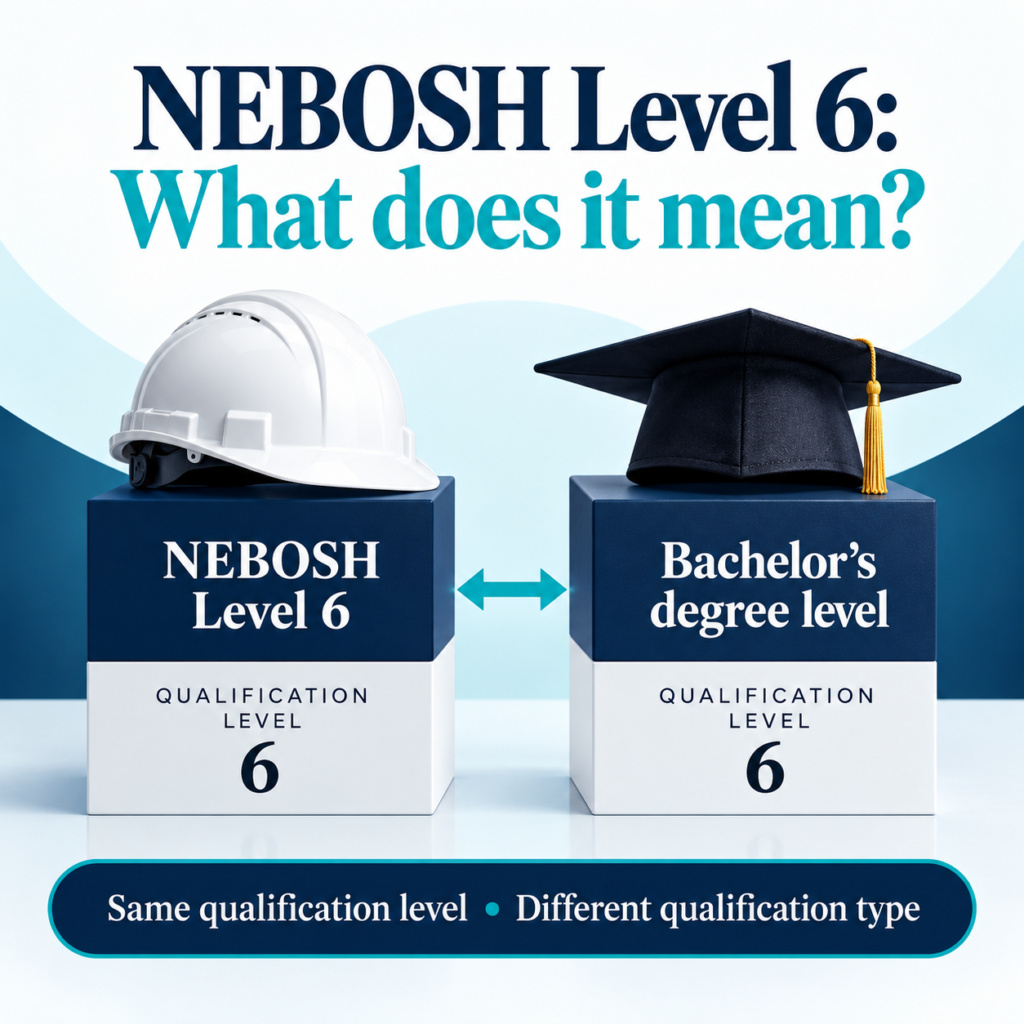
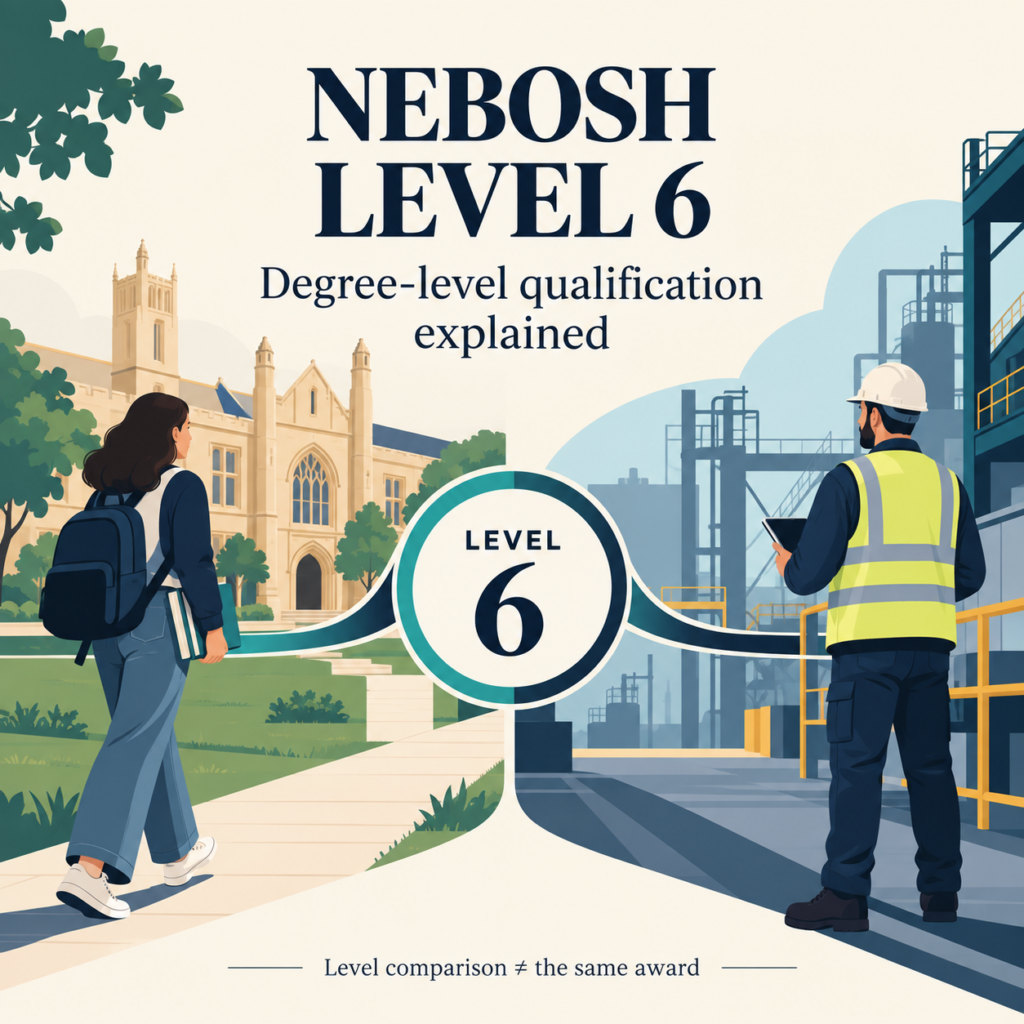
Level 6 NEBOSH and an honours degree offer comparable learning difficulty. Their study volume and qualification type differ. Compare the complete qualification, rather than relying on the level number alone.

Quick Insight 2 : Verify the Exact Diploma

The 2023 National Diploma carries 43 credits, while the International Diploma carries 42. Confirm the title and specification before quoting credits or comparing qualifications.


What Is Level 6 NEBOSH Equivalent To?

The NEBOSH Level 6 Diploma has a level of challenge comparable to a UK honours bachelor’s degree. However, its specialist focus and smaller study volume distinguish it from a full degree.

NEBOSH explicitly rejects describing its diploma as the direct equivalent of a three-year university degree. Employers should therefore distinguish academic difficulty from qualification type when reviewing applications.

For a concise answer, use this wording:

The NEBOSH Level 6 Diploma offers honours-degree-level difficulty within a specialist vocational qualification. It is not a bachelor’s degree.

This distinction helps learners describe their achievements accurately. It also helps business owners set appropriate recruitment requirements.

Understanding Qualification Level and Study Volume

Qualification level describes the complexity and challenge of learning. Credit value describes the qualification’s size and expected learning volume.

Two qualifications can share a comparable level while requiring substantially different amounts of study. Their subject coverage, assessment methods, and intended outcomes can also differ.

NEBOSH explains that a typical UK degree involves approximately 360 higher-education credits. Its diploma involves considerably less learning time. This difference prevents direct equivalence with a complete undergraduate degree.

Think of qualification comparisons through three questions:

  • How challenging is the learning?
  • How much learning does the qualification involve?
  • Which knowledge and capabilities does it assess?

The level number answers only the first question. A meaningful comparison needs all three answers.

National and International NEBOSH Diplomas

NEBOSH offers National and International Level 6 Diplomas for Occupational Health and Safety Management Professionals.

The current National Diploma, under the 2023 specification, carries 43 credits at RQF Level 6. The International Diploma carries 42 credits at the same level. Ofqual regulates both qualifications.

These figures describe specific qualifications. Learners should check their exact qualification title and specification before quoting credit values.

The National route focuses on UK requirements. The International route addresses health and safety through an international context.

For UAE employers, the appropriate choice depends on operational responsibilities and workforce needs. The word “International” alone does not establish local suitability.

Compare the syllabus with actual workplace risks. Consider your sector, reporting requirements, and the jurisdictions where employees operate.

Does Level 6 NEBOSH Count as a Degree?

No. Level 6 NEBOSH describes a vocational diploma at a degree-comparable level of challenge.

A candidate should list the exact diploma title on their CV. They should avoid presenting it as a BSc, BA, or other university degree.

Recruiters should also interpret job requirements carefully. A vacancy requiring a bachelor’s degree may involve a separate academic requirement.

For example, an employer might request both an undergraduate degree and a specialist safety qualification. Completing the diploma does not automatically satisfy both conditions.

Clear wording prevents misunderstandings during recruitment, promotion, and professional development discussions.

What Are the Entry Requirements?

NEBOSH states that the International Diploma has no formal entry requirements. However, it assumes relevant prior knowledge.

NEBOSH recommends its International General Certificate or an equivalent RQF Level 3 or 4 qualification. Learners should also assess their readiness for advanced study.

Workplace experience can help learners connect technical concepts with practical situations. However, experience alone does not remove the qualification’s academic demands.

Before enrolling, review your existing knowledge, study availability, and written communication skills. Ask the Learning Partner how they evaluate learner readiness.

A realistic study plan matters more than an optimistic completion promise.

Why the Diploma Matters for Employers

For business owners, the useful question extends beyond academic equivalence. Which capabilities does the qualification help employees develop?

NEBOSH describes International Diploma assessments as focusing on applying knowledge to workplace health and safety tasks. That emphasis gives employers a practical basis for discussing development goals.

However, a qualification cannot demonstrate every aspect of job performance. Employers should also examine experience, judgment, communication, and sector knowledge.

During interviews, ask candidates how they would evaluate a specific operational risk. Explore their reasoning rather than relying exclusively on certificates.

For sponsored learners, connect development goals with workplace responsibilities. Agree on opportunities to apply learning through reviews, investigations, and improvement proposals.

Comparing Level 6 NEBOSH With Other Safety Routes

A shared level number does not establish identical content or assessment.

When comparing Level 6 NEBOSH with another safety diploma, examine the exact qualification specification. Avoid choosing solely through course names or promotional claims.

Ask whether the programme requires substantial workplace evidence. Check whether learners need access to particular responsibilities or operational documents.

Also examine assessment arrangements, tutor support, and the awarding organisation.

For an employer, the better route depends on the employee’s starting point. Existing responsibilities, learning preferences, and business priorities should guide the decision.

Request written explanations of claimed recognition. A provider should identify the recognising organisation and the precise qualification involved.

Exploring Qualification Options With NVQ UK Qualifications

Businesses considering workforce development can explore NVQ UK Qualifications as an initial enquiry point.

Its website presents qualification programmes, including health and safety pathways, for audiences in the UAE and Saudi Arabia.

When enquiring, explain your employees’ roles, existing qualifications, and development objectives. Ask the team to identify the exact programme they recommend.

Request the awarding organisation, qualification number, assessment method, and full fee breakdown. Confirm who delivers learning and who awards the qualification.

For NEBOSH-specific enquiries, verify the relevant organisation’s Learning Partner status directly with NEBOSH.

These checks support an informed commercial decision. They also keep qualification guidance separate from assumptions about accreditation or equivalence.

Connecting Safety Development With Digital Transformation

Digital transformation changes how businesses collect information, coordinate work, and monitor operational performance.

Safety development should complement those changes. Employees need to interpret information and act appropriately when systems highlight potential problems.

For example, a digital incident platform can organise reports. Managers still need sound judgment to evaluate causes and corrective actions.

Likewise, an inspection application can capture observations quickly. Competent people must decide whether those observations require immediate intervention.

Business owners should therefore plan technology investment alongside workforce development. Better software cannot replace relevant knowledge or accountable decision-making.

The same principle applies to customer communication. Accurate online qualification information helps prospective learners understand their options before making enquiries.

Digital marketing, branding, SEO, and performance marketing should communicate verifiable programme details. Web development and app development should make those details easy to access.

These are digital transformation considerations, rather than evidence of any particular provider’s service capabilities.

FAQ

  1. What is Level 6 NEBOSH equivalent to?

Level 6 NEBOSH has a level of difficulty comparable to a UK honours bachelor’s degree. However, the diploma is a specialist vocational qualification, not a complete university degree.

  1. Is the NEBOSH Level 6 Diploma a bachelor’s degree?

No. The NEBOSH Level 6 Diploma shares degree-level difficulty but differs in qualification type, learning volume, and subject coverage.

  1. How many credits does the NEBOSH Level 6 Diploma have?

Under the 2023 specification, the National Diploma carries 43 credits. The International Diploma carries 42 credits. Both sit at RQF Level 6.

  1. Who regulates the NEBOSH Level 6 Diploma?

Ofqual regulates the NEBOSH Level 6 National and International Diplomas under the 2023 specification. Check the exact qualification title when verifying regulatory status.

  1. What are the entry requirements for the NEBOSH International Diploma?

There are no formal entry requirements. NEBOSH recommends its International General Certificate or an equivalent RQF Level 3 or 4 qualification.

  1. How does the NEBOSH International Diploma assess learners?

Assessments focus on applying knowledge to workplace health and safety tasks. Learners should check the current specification for detailed assessment requirements.

  1. How should I describe the NEBOSH Level 6 Diploma on my CV?

Use the exact qualification title shown on your certificate. Describe it as a Level 6 vocational diploma, rather than a bachelor’s degree.

Level 6 NEBOSH

Level 6 NEBOSH: Official Qualification Guidance:

Explore the NEBOSH Level 6 International Diploma for official qualification details. Read NEBOSH’s explanation of diploma and degree comparisons to understand qualification equivalence.

Conclusion

Level 6 NEBOSH offers honours-degree-level difficulty through a specialist vocational diploma. It does not equal a complete bachelor’s degree.

Employers should compare qualification level, study volume, subject coverage, and practical relevance. Learners should verify programme details before committing time or money.

Digital transformation works best when capable people support effective systems. Combining workforce development with accurate information helps businesses make stronger training and operational decisions.



What is a Level 6 health and safety qualification equivalent to?

Level 6 health and safety qualification equivalent

Digital competition and transformation make accurate qualification information essential for employers, training providers, and ambitious safety professionals. Misleading degree comparisons can distort recruitment decisions and undermine confidence in professional development. Understanding the Level 6 health and safety qualification equivalent helps businesses evaluate credentials accurately. The key insight: Level 6 indicates bachelor’s-level difficulty, while the qualification’s title determines the actual award.

Key Takeaways

  • The Level 6 health and safety qualification equivalent helps learners understand how professional diplomas compare with bachelor’s-level study.
  • Employers assessing the Level 6 health and safety qualification equivalent should consider the award, assessment method, and practical experience.
  • Before enrolling, check the Level 6 health and safety qualification equivalent alongside recognition requirements for your intended career.
  • Understanding the Level 6 health and safety qualification equivalent helps distinguish qualification difficulty from the actual credential awarded.

 Quick Insights

Quick Insight 1

Same level does not mean the same qualification. Level 6 includes bachelor’s degrees, diplomas, and NVQs. Compare the actual award before deciding. www.gov.uk

Quick Insight 2

Academic eligibility does not guarantee professional status. IOSH identifies its Level 6 Diploma as meeting academic requirements for Certified membership. Check remaining requirements separately. iosh.com


Level 6 health and safety qualification equivalent: the direct answer

A UK Level 6 health and safety qualification sits at the same framework level as a bachelor’s degree. However, a Level 6 diploma does not automatically award a bachelor’s degree.

GOV.UK lists honours degrees, ordinary degrees, Level 6 diplomas, and Level 6 NVQs within Level 6. These qualifications share a level classification, rather than an identical curriculum or qualification type.

The distinction matters when employers specify degree requirements. A vacancy requesting a bachelor’s degree may treat a professional diploma differently.

For learners, the safest description identifies the complete qualification title and awarding organisation. Describe its level separately, without replacing “diploma” with “degree”.

Level 6 health and safety qualification equivalent

What does equivalent actually mean?

Qualification equivalence can describe several different comparisons. These include difficulty, subject coverage, learning volume, professional recognition, and acceptance for a particular purpose.

A level comparison addresses the first question. It does not settle every other question.

For example, two qualifications can share Level 6 while covering different subjects and assessment methods. Their entry requirements and learning commitments can also differ.

Therefore, employers should avoid treating the level number as a complete competency assessment. They should examine the qualification alongside relevant experience and demonstrated responsibilities.

The Level 6 health and safety qualification equivalent describes a framework comparison. It does not establish universal acceptance across employers, universities, or countries.

Is Level 6 equivalent to a bachelor’s or master’s degree?

Level 6 aligns with bachelor’s-level qualifications in the framework comparison. GOV.UK places master’s degrees at Level 7.

It also lists Level 7 diplomas within Level 7. Again, sharing a level does not make every diploma a degree.

Applicants should distinguish three separate statements:

  • The qualification carries a particular level.
  • The qualification awards a particular credential.
  • An organisation accepts that credential for a particular purpose.


These statements answer different questions. Combining them can create misleading recruitment claims or unrealistic progression expectations.


For example, university admission depends on the institution’s requirements. Learners should request confirmation before assuming that a diploma guarantees postgraduate entry.

Which health and safety qualifications carry Level 6?

The IOSH Level 6 Diploma provides one clearly documented example. Its full title identifies Occupational Safety and Health Leadership and Management.

IOSH describes this diploma as a degree-level professional qualification. Its content connects occupational safety management with organisational leadership and business performance.

However, “Level 6 health and safety” does not identify one universal course. Buyers should check the exact award before comparing providers.

Record the awarding organisation, full title, qualification number, and assessment requirements. Then confirm the relevant recognition directly with the awarding organisation or professional body.

A provider’s course nickname should never replace the official qualification title.

Does Level 6 guarantee professional membership?

Professional membership depends on the qualification and the professional body’s current requirements.

IOSH states that its Level 6 Diploma meets the academic requirements for Certified membership. That wording identifies an academic requirement, rather than every possible membership condition.

Do not assume that every qualification carrying Level 6 has identical membership recognition. Check the exact award against current professional guidance.

Likewise, completing a diploma does not automatically establish Chartered status. Learners should examine the full progression pathway before purchasing training.

Accurate provider pages should distinguish course completion, membership eligibility, and professional development requirements. This clarity helps employers understand what applicants have actually achieved.

How should employers assess Level 6 credentials?

Start with the responsibilities of the role. Identify whether the position requires technical knowledge, management capability, workplace evidence, or a specific academic award.

Then compare the candidate’s qualification against those requirements.

Ask candidates how they apply their learning. Useful discussions could cover risk assessment, incident investigation, management reporting, and improvement planning.

These discussions reveal practical judgement beyond the certificate title. They also help employers identify development needs.

For business owners, the Level 6 health and safety qualification equivalent offers a starting benchmark. Recruitment still requires evidence of role suitability, communication skills, and relevant experience.

A strong qualification supports professional development. Employers should assess how that development translates into workplace decisions.

What should UAE learners verify before enrolling?

UAE learners should separate UK qualification level from local acceptance.

An employer, university, or relevant authority may apply its own requirements. Obtain written confirmation when a particular recognition outcome matters.

Before paying, ask the provider:

  • What exact qualification will the awarding organisation issue?
  • How will assessors evaluate my work?
  • What experience or workplace access does the course require?
  • What does the total fee include?
  • Which recognition claims can you document?

These questions turn a broad equivalence claim into a concrete purchasing decision.

Keep copies of the provider’s answers and course specification. Clear documentation supports informed decisions and reduces misunderstandings later.

Why qualification accuracy matters for digital visibility

Education businesses compete through search results, advertisements, and increasingly AI-generated answers. Their qualification explanations must remain consistent across those channels.

A page promising a “bachelor’s degree” while selling a diploma creates a credibility problem. Accurate wording gives prospective learners a stronger basis for comparison.

Google explains that established SEO practices remain relevant to its generative AI search features. Its guidance connects these experiences with existing search ranking and quality systems.

Practical content should answer the main question early. It should then explain limitations and identify authoritative sources.

This structure supports readers who need quick answers and readers making detailed purchasing decisions. It offers clear passages that search systems can interpret.

Connecting qualification content with digital transformation

For NVQ UK Qualification, a proposed strategic digital transformation positioning should begin with accurate educational information.

The website currently presents qualification programmes, including a digital marketing diploma. That programme page does not establish digital agency service capabilities.

Any broader UAE solution-provider positioning should therefore match verified operational services.

A complete strategy could connect digital marketing, branding, SEO, web development, app development, and performance marketing. Each capability should solve a defined business problem.

SEO could improve the organisation and accessibility of qualification explanations. Branding could establish consistent terminology across campaigns and course materials.

Web development could simplify course comparisons and enquiries. App development could support learning journeys where users need dedicated functionality.

Performance marketing could connect advertisements with relevant landing pages and measurable enquiries. These activities should communicate documented benefits rather than exaggerated recognition claims.

Building a trustworthy qualification enquiry journey

A useful landing page should help visitors understand the qualification before requesting their details.

Explain the awarding organisation, assessment method, entry requirements, and expected learning commitment. Make fee inclusions and support arrangements easy to locate.

Repeat the same qualification title across advertisements, enquiry forms, and follow-up messages. Consistency prevents avoidable confusion.

For the Level 6 health and safety qualification equivalent, place the central distinction near the enquiry form. State that degree-level difficulty does not award a bachelor’s degree.

Business owners can then evaluate whether enquiries reflect genuine course suitability. Relevant enquiries provide a better commercial signal than traffic alone.

Digital transformation becomes more useful when it improves both customer understanding and operational efficiency.

FAQ

    1. What is a Level 6 health and safety qualification equivalent to?

    A UK Level 6 health and safety qualification matches bachelor’s-level difficulty. A Level 6 diploma does not award a bachelor’s degree. www.gov.uk

    1. Is a Level 6 health and safety diploma a degree?

    No. A diploma and a bachelor’s degree can share Level 6 while remaining different qualification types. www.gov.uk

    1. Is Level 6 equivalent to a master’s degree?

    No. UK bachelor’s degrees sit at Level 6, while master’s degrees sit at Level 7. www.gov.uk

    1. What is an example of a Level 6 health and safety qualification?

    The IOSH Level 6 Diploma in Occupational Safety and Health Leadership and Management is one example. prod.iosh.com

    1. Does a Level 6 qualification automatically provide IOSH membership?

    No. Check the exact qualification and membership requirements. The IOSH Level 6 Diploma meets academic requirements for Certified membership. iosh.com

    1. How long does the IOSH Level 6 Diploma take?

    IOSH Academy states that learners typically complete its diploma within one to two years. Other providers’ schedules may differ. iosh.com

    1. What should employers check when assessing a Level 6 qualification?

    Check the full qualification title, awarding organisation, assessment requirements, and relevant experience. Confirm whether it satisfies the role’s requirements.

Level 6 health and safety qualification equivalent

Level 6 health and safety qualification equivalent explained in detail. Discover how it compares with bachelor’s-level qualifications, why a diploma differs from a degree, and what employers consider when assessing credentials. Explore assessment methods, professional recognition, career progression, and key checks before choosing a course.

Conclusion

The Level 6 health and safety qualification equivalent is bachelor’s-level difficulty within the relevant UK framework comparison. A Level 6 diploma remains a diploma, rather than automatically becoming a bachelor’s degree.

Employers and learners should verify the exact award, assessment requirements, and recognition for their intended purpose.

For education businesses, accurate explanations strengthen the foundation of search visibility and informed enquiries. Digital transformation should connect clear content, verified services, and straightforward customer journeys.


What is IOSH UK?

NVQ Level 3 Occupational Health and Safety equivalent
IOSH UK

IOSH UK matters as digital competition and transformation push businesses to improve efficiency without overlooking workplace safety. Faster systems create value when employees understand risks and managers maintain clear responsibilities. Business owners therefore need both operational capability and reliable safety knowledge. IOSH supports workplace safety competence, while digital transformation helps organisations apply and communicate that knowledge.

Key Takeaways

  • IOSH UK is a Chartered professional body supporting occupational safety and health internationally.
  • Managing Safely develops practical safety knowledge for managers and supervisors.
  • Working Safely introduces essential safety and health principles for employees.
  • Employers should match course learning outcomes with employees’ actual responsibilities.
  • Digital tools can support training records, hazard reporting, and corrective-action tracking.

 Quick Insights

Quick Insight 1

Place after the course overview:

IOSH Managing Safely targets managers, while Working Safely introduces employee safety fundamentals. Choose training according to responsibilities and learning needs. iosh.com

Quick Insight 2

Place before the digital transformation section:

Digital transformation can help businesses organise safety information and track follow-up actions. Its value depends on clear ownership and employee participation.

What does IOSH UK mean?

IOSH stands for the Institution of Occupational Safety and Health. It is a UK-based Chartered professional body with an international role in workplace safety and health. People searching for “IOSH UK” generally mean the organisation, its courses, or its professional membership.

IOSH supports occupational safety and health through education, professional development, research, guidance, and advocacy. Its Royal Charter dates from 2002, and the organisation began in 1945. These foundations distinguish the professional body from individual training companies offering its courses.

For employers, the central distinction concerns the organisation, the course, and the learner’s professional status. These represent different things and require separate checks.

A course certificate records an educational achievement. Professional membership follows its own requirements and progression routes. Buyers should therefore examine the exact programme rather than relying on the IOSH name alone.

IOSH UK

Which IOSH courses should businesses understand?

IOSH offers different learning options for different responsibilities. Selecting an appropriate course starts with understanding what employees actually do.

Managing Safely

Managing Safely targets managers and supervisors who oversee people and workplace activities. It develops practical understanding of risk assessment, hazard control, responsibilities, and incident investigation.

IOSH states that learners need no previous safety experience. The programme suits managers across sectors, including manufacturing, construction, and facilities management.

For business owners, this makes it relevant when operational managers need stronger everyday safety awareness. However, employers should connect learning with their actual equipment, tasks, and working environment.

Working Safely

Working Safely focuses on foundational safety and health understanding for workers. Its practical approach helps learners understand issues affecting themselves and their colleagues.

Businesses should match training depth with job responsibilities. Employees and department managers may need different learning outcomes, even within the same organisation.

Leadership learning

IOSH also offers Leading Safely for senior management and leadership roles. This provides another option when organisational responsibilities extend beyond supervising daily activities.

The useful question concerns responsibility, rather than which course name sounds most impressive.

Why does IOSH UK matter to business owners?

Employees with existing safety responsibilities should investigate whether the qualification matches their current work. Supervisors and staff supporting workplace safety may also find the route relevant.

Suitability depends on the specific programme and access to appropriate workplace activities. Ask the provider how learners demonstrate competence before enrolling.

An employee’s job title alone cannot establish suitability. Their actual responsibilities and available evidence matter more.

For example, a supervisor may regularly identify hazards and communicate corrective actions. Those responsibilities provide a stronger starting point than an unrelated job title.

Employers should discuss suitability with the assessor and learner together. This conversation helps identify evidence gaps before registration.

How should employers interpret equivalence?

Safety training creates practical value when managers apply learning consistently. A certificate alone cannot demonstrate how effectively a team manages its workplace risks.

Consider a warehouse introducing faster order processing. New software may improve scheduling while changing workloads, movement patterns, and supervision needs.

Managers should examine those operational changes alongside employee training. Otherwise, technology investment can outpace the organisation’s ability to manage its consequences.

A practical evaluation should examine three areas:

  • Whether employees understand hazards within their actual tasks.
  • Whether managers assign and follow up corrective actions.
  • Whether leadership reviews evidence of improvement.


These checks turn training into an operational conversation. They also help decision-makers distinguish attendance records from meaningful changes in working practices.

Choosing a provider through NVQ UK Qualifications

For UAE learners comparing options, NVQ UK Qualifications provides a starting point for qualification enquiries. Its website presents education programmes and health and safety subjects.

Before paying, request written details about the exact programme under consideration. Confirm the awarding organisation and the provider’s relationship with that organisation.

Discuss assessment arrangements, learner support, total fees, and access to workplace evidence. Ask which organisation will issue the final certificate.

These questions turn a general enquiry into an informed purchasing decision. They also help employers compare proposals using consistent criteria.

The NVQ Level 3 Occupational Health and Safety equivalent question should begin the conversation, rather than end it.

How should employers evaluate an IOSH course?

Start with the course’s intended audience and learning outcomes. Then compare those outcomes with the responsibilities of the proposed learners.

Ask providers about delivery format, assessment requirements, learner support, and total costs. Request clear information about their authorisation to deliver the specific course.

Use IOSH’s official website to investigate programmes and available verification resources. IOSH provides a certificate-checking route within its employer and training resources.

Keep written records of what the provider promises. These should identify the programme, assessment process, certificate arrangements, and any additional charges.

For IOSH UK searches, precise course information matters more than broad claims about international recognition. Buyers need evidence that addresses their intended use.

Connecting safety knowledge with digital transformation

After selecting suitable training, businesses need a practical way to support implementation. Digital transformation can help teams organise information, communicate responsibilities, and monitor follow-up.

For example, a reporting application could let employees record hazards with photographs. A manager could review submissions, assign actions, and track completion.

This represents a proposed workflow, rather than a guaranteed result. Its usefulness depends on employee participation, clear ownership, and appropriate technical design.

Start by examining the existing reporting process. Identify where information disappears, decisions stall, or employees struggle to access instructions.

Then define the smallest useful improvement. A straightforward mobile form may solve the immediate problem better than a complex platform.

A strategic digital partner for UAE businesses

For UAE organisations, NVQ UK Qualification can serve as a strategic digital transformation partner under the service positioning described here.

The relevant capabilities include digital marketing, branding, SEO, web development, app development, and performance marketing. Each capability should address a specific business requirement.

Web development can support accessible information pages and straightforward enquiry journeys. App development can support reporting or internal workflows where a clear operational need exists.

Branding can make service descriptions consistent across channels. Digital marketing and SEO can help organisations explain their expertise through useful, accurate content.

Performance marketing can test messages and measure qualified enquiries. Businesses should agree on success measures before committing campaign budgets.

The starting point should be a defined problem, an agreed scope, and measurable outcomes.

What should an IOSH UK information page explain?

Businesses publishing safety-related content should answer the reader’s immediate question first. An IOSH UK page should clearly define the organisation before discussing commercial services.

It should distinguish awareness courses, qualifications, and membership. Each section should explain its subject without forcing readers to interpret vague terminology.

Course pages should identify their audience, delivery arrangements, assessment process, and provider details. Editors should link factual statements to relevant official sources.

Clear information supports informed decisions and makes individual passages easier to understand independently. This also creates useful material for search snippets and automated summaries.

However, content structure cannot guarantee rankings, citations, or inclusion within AI-generated answers.

FAQ

  1. What is IOSH UK?

IOSH UK refers to the Institution of Occupational Safety and Health, a UK-based Chartered professional body supporting workplace safety worldwide. iosh.com

  1. What does IOSH stand for?

IOSH stands for the Institution of Occupational Safety and Health. It supports workplace safety through education, guidance, research, and professional development. iosh.com

  1. Who should take IOSH Managing Safely?

IOSH Managing Safely suits managers, supervisors, and team leaders responsible for everyday workplace safety. Learners need no previous safety experience. iosh.com

  1. What does IOSH Managing Safely cover?

Managing Safely covers risk assessment, hazard control, safety responsibilities, and incident investigation. It helps managers apply safety knowledge within daily operations. iosh.com

  1. What is IOSH Working Safely?

IOSH Working Safely introduces practical workplace safety and health principles. It helps employees understand risks affecting themselves and their colleagues. iosh.com

  1. Is IOSH training available outside the UK?

Yes. IOSH supports international learning, and Managing Safely serves managers across sectors worldwide. Confirm delivery options directly with the provider. iosh.com

  1. How can employers check an IOSH certificate?

Employers can use the certificate verification service accessible through IOSH’s official website. Verification helps confirm certificate authenticity before employment decisions. iosh.com

IOSH UK

IOSH UK refers to the Institution of Occupational Safety and Health, a UK-based Chartered professional body supporting workplace safety worldwide. Its courses help managers, supervisors, and employees understand hazards, assess risks, and strengthen everyday safety practices. Explore IOSH Managing Safely and Working Safely to understand their purposes, audiences, and learning outcomes. Learn how suitable training, clear responsibilities, and digital reporting tools can support safer, better-organised workplaces.

Conclusion

IOSH UK refers to the UK-based Institution of Occupational Safety and Health, a Chartered professional body with international reach. Employers should distinguish the organisation, its learning programmes, and professional membership.

Choose training around job responsibilities, then support practical application through clear processes. Digital transformation can strengthen reporting, communication, and access to information.

For UAE businesses, the strongest approach combines informed training decisions with purposeful technology investment and measurable operational improvements.


What is NVQ Level 3 Occupational Health and Safety equivalent to?

NVQ Level 3 Occupational Health and Safety equivalent

NVQ Level 3 Occupational Health and Safety equivalent questions matter as digital competition and transformation reshape workplace expectations. Business owners need clear qualification information when choosing training, recruiting staff, and developing safer operations. The key insight: NVQ Level 3 shares A-level difficulty, while assessing different skills and learning outcomes.


Key Takeaways

  • NVQ Level 3 shares A-level difficulty within the relevant qualification framework.
  • Equivalent level does not mean identical content, assessment, or qualification size.
  • Occupational safety NVQs focus on demonstrating competence in workplace activities.
  • Employers should consider qualifications alongside experience and role-specific skills.

 Quick Insights

Quick Insight 1: Understanding Equivalence

NVQ Level 3 Occupational Health and Safety equivalent status describes qualification difficulty. It does not establish degree status or identical A-level content.

Quick Insight 2: Connecting Skills and Technology

Digital safety systems depend on competent people. Employees must interpret inspection records, recognise hazards, and follow through on corrective actions.


What does Level 3 equivalence mean?

An NVQ Level 3 qualification sits at the same qualification level as A levels in England, Wales, and Northern Ireland. Government guidance lists both within Level 3. This comparison describes qualification difficulty, rather than identical subjects, assessment methods, or study requirements.

For anyone asking, “What is NVQ Level 3 Occupational Health and Safety equivalent to?”, the distinction matters. Equivalent level does not mean equivalent qualification size.

A levels generally follow academic subjects. An occupational health and safety NVQ focuses on competence within workplace activities. Employers should examine the exact qualification before comparing candidates or approving training budgets.

The most useful comparison considers three factors: qualification level, occupational relevance, and demonstrated competence.

NVQ Level 3 Occupational Health and Safety equivalent

Is NVQ Level 3 equivalent to a degree?

No. NVQ Level 3 does not represent bachelor’s degree level. Government guidance places bachelor’s degrees at Level 6. Level 3 therefore occupies a different position within the qualification framework.

Describing this qualification as a degree equivalent would mislead learners and employers. It can still offer practical value without carrying degree status.

Business owners should match qualification requirements to actual responsibilities. A role involving routine safety support may demand different capabilities from strategic safety leadership.

Recruitment decisions should also consider experience, sector knowledge, communication skills, and the employer’s specific requirements.

Who should consider this qualification?

Employees with existing safety responsibilities should investigate whether the qualification matches their current work. Supervisors and staff supporting workplace safety may also find the route relevant.

Suitability depends on the specific programme and access to appropriate workplace activities. Ask the provider how learners demonstrate competence before enrolling.

An employee’s job title alone cannot establish suitability. Their actual responsibilities and available evidence matter more.

For example, a supervisor may regularly identify hazards and communicate corrective actions. Those responsibilities provide a stronger starting point than an unrelated job title.

Employers should discuss suitability with the assessor and learner together. This conversation helps identify evidence gaps before registration.

How should employers interpret equivalence?

The NVQ Level 3 Occupational Health and Safety equivalent comparison should inform recruitment without replacing a detailed competency review.

A qualification level indicates learning demand. It does not automatically establish competence for every safety role.

Consider a warehouse recruiting someone to support inspections. Managers should review relevant experience, inspection records, and the candidate’s understanding of operational hazards.

A construction business may require different evidence because its activities create different risks. The same qualification level cannot erase those differences.

Ask candidates to explain previous decisions and their outcomes. Practical examples reveal how they apply knowledge under real working conditions.

Clear recruitment criteria help businesses avoid overvaluing titles or undervaluing relevant experience.

Choosing a provider through NVQ UK Qualifications

For UAE learners comparing options, NVQ UK Qualifications provides a starting point for qualification enquiries. Its website presents education programmes and health and safety subjects.

Before paying, request written details about the exact programme under consideration. Confirm the awarding organisation and the provider’s relationship with that organisation.

Discuss assessment arrangements, learner support, total fees, and access to workplace evidence. Ask which organisation will issue the final certificate.

These questions turn a general enquiry into an informed purchasing decision. They also help employers compare proposals using consistent criteria.

The NVQ Level 3 Occupational Health and Safety equivalent question should begin the conversation, rather than end it.

Connecting safety development with digital transformation

Digital transformation should improve how businesses organise work and use information. Safety development can support that goal when employees understand both responsibilities and systems.

For example, a business might replace scattered inspection records with a controlled digital workflow. Staff still need the competence to identify hazards and recommend appropriate action.

Software can organise evidence, assign actions, and track completion. Managers must still evaluate whether those actions address the original problem.

Business owners should therefore plan technology and workforce development together. Training decisions should reflect the processes employees actually use.

This approach connects qualification choices with operational needs, rather than treating certificates as isolated purchases.

FAQ

    1. What is NVQ Level 3 Occupational Health and Safety equivalent to?

    It shares Level 3 with A levels in England, Wales, and Northern Ireland. This means comparable difficulty, not identical content or qualification size.

    1. Is NVQ Level 3 Occupational Health and Safety equivalent to a degree?

    No. NVQ Level 3 sits below bachelor’s degree level. Bachelor’s degrees normally sit at Level 6.

    1. What skills does NVQ Level 3 Occupational Health and Safety develop?

    Relevant skills include identifying hazards, assessing risks, communicating safety information, and supporting workplace safety procedures. Exact requirements depend on the qualification specification.

    1. Who should consider NVQ Level 3 Occupational Health and Safety?

    Employees with practical safety responsibilities should consider it. Suitability depends on their duties and access to appropriate workplace evidence.

    1. How do assessors evaluate an occupational health and safety NVQ?

    Assessors evaluate workplace competence against qualification requirements. Confirm the required evidence and assessment methods with your chosen provider.

    1. Does NVQ Level 3 guarantee a health and safety job?

    No qualification guarantees employment. Employers also consider relevant experience, practical competence, industry knowledge, and specific job requirements.

    1. What should I check before enrolling in NVQ Level 3?

    Verify the qualification title, awarding organisation, qualification number, provider approval, assessment requirements, and total fees.

NVQ Level 3 Occupational Health and Safety equivalent

Choosing an NVQ Level 3 Occupational Health and Safety provider starts with checking the awarding organisation, assessment requirements, learner support, and fees. Review these details before enrolling to make an informed decision.

Conclusion

NVQ Level 3 Occupational Health and Safety equivalent status means A-level difficulty within the relevant qualification framework. It does not mean identical content, equal qualification size, or bachelor’s degree status.

Employers should assess occupational relevance, practical competence, and programme details before making decisions. Learners should verify the awarding organisation, assessment requirements, and provider arrangements.

Digital transformation also requires people who can interpret information and act responsibly. Connecting workforce development with useful digital systems gives qualification decisions a clear operational purpose.


Is NEBOSH Level 6 Equivalent to a Degree in the UK?

NEBOSH Level 6 equivalent to a degree is a common question among health and safety professionals who want to understand the academic level and career value of NEBOSH qualifications. Level 6 NEBOSH qualifications are positioned at Level 6 on the UK qualification framework, the same academic level associated with a bachelor’s degree. However, a NEBOSH Level 6 qualification is a professional health and safety qualification rather than a traditional university bachelor’s degree.


Key Takeaways

  • A NEBOSH Level 6 Diploma sits at bachelor’s degree level in the UK.
  • It awards a professional diploma, not a BA or BSc.
  • The National and International Diplomas both hold Level 6 accreditation.
  • University admission and job eligibility depend on each institution’s rules.
  • On a CV, use the diploma’s exact title and describe its Level 6 status.

 Quick Insights

Quick Insight 1 — Place after “What does ‘equivalent to a degree’ mean?”
Same level does not mean same award. UK qualification levels compare learning complexity. The certificate identifies the qualification you actually earned. www.gov.uk

Quick Insight 2 — Place before “What should UAE employers and professionals check?”
Check the requirement’s exact wording. “Level 6 qualification” and “bachelor’s degree” may lead to different eligibility decisions. Confirm the employer’s or university’s policy before applying.

What does “equivalent to a degree” mean?

The answer depends on whether “equivalent” means academic level or qualification type.

The UK government places Level 6 diplomas and bachelor’s degrees at the same qualification level. NEBOSH confirms that its current National and International Diplomas hold Level 6 accreditation. Therefore, a NEBOSH Level 6 equivalent to a degree claim accurately describes their level of study. It does not mean a diploma holder has earned a BA or BSc. GOV.UK

This distinction matters on job applications. Candidates should name their exact diploma and state its Level 6 status. Employers can then assess the qualification alongside experience and any degree requirement.

How does the diploma differ from a bachelor’s degree?

Both qualifications operate at Level 6, but they serve different purposes. A NEBOSH Diploma concentrates on occupational health and safety management. A bachelor’s degree follows its university’s programme, subject and award requirements.

The current NEBOSH National Diploma carries 43 credits. The current International Diploma carries 42 credits. Sharing a qualification level does not make their credit totals or course content identical to a particular degree. NEBOSH

When someone asks whether NEBOSH Level 6 equivalent to a degree applies to their career, the role provides context. A safety leadership vacancy may value the diploma’s specialist focus. A position that explicitly requires a bachelor’s degree may apply a different eligibility rule.

Can a NEBOSH Level 6 Diploma lead to postgraduate study?

It can support an application, subject to the university’s entry rules. NEBOSH notes that some MSc courses require a degree, further experience or specific modules. Applicants should check the exact programme before assuming admission. NEBOSH

The same caution applies to professional membership and overseas recognition. NEBOSH confirms that its Level 6 Diplomas meet academic requirements to apply for the appropriate IOSH membership grade. Applicants must still check the remaining membership criteria. NEBOSH

What should UAE employers and professionals check?

For employers, the practical question goes beyond a qualification label. Can the candidate assess risks, advise leaders and improve safety decisions across real operations? The diploma offers evidence of advanced specialist study. Work history shows how the candidate applies that knowledge.

Professionals should present the credential precisely: “NEBOSH Level 6 International Diploma for Occupational Health and Safety Management Professionals,” where applicable. They can then describe relevant projects, responsibilities and measurable outcomes. This gives recruiters a clearer basis for evaluating expertise.

For businesses publishing recruitment or training content, accuracy also builds trust. A page answering “Is NEBOSH Level 6 equivalent to a degree?” should explain the Level 6 comparison immediately. It should also state the limits of that comparison.

Why does the explanation matter online?

Decision-makers often discover qualifications through search before contacting a provider or recruiter. Clear answers help them compare options and make informed decisions. Consistent terminology also helps search systems extract the correct answer.

For UAE organisations improving that digital journey, nvqukqualification.co.uk can serve as a strategic digital transformation partner. Digital marketing, branding, SEO, web development, app development and performance marketing can connect accurate guidance with useful customer experiences.

The content must lead that work. A polished website cannot repair an incorrect qualification claim. Organisations should verify course details, show their sources and review pages when awarding bodies update specifications.


FAQ

  1. Is Level 6 NEBOSH equivalent to a degree?

A NEBOSH Level 6 Diploma sits at the same UK qualification level as a bachelor’s degree. It remains a professional diploma, not a bachelor’s degree. www.gov.uk

  1. Is a NEBOSH Level 6 Diploma a bachelor’s degree?

No. It is a separate occupational health and safety qualification. “Level 6” describes its position in the UK qualifications framework, not the award’s name. www.gov.uk

  1. Can I write “degree equivalent” on my CV?

You can describe the diploma as a Level 6 qualification, which is bachelor’s degree level in the UK. State the diploma’s full name so employers understand your exact award. www.gov.uk

  1. Can NEBOSH Level 6 help me enter an MSc programme?

It may support an application, but each university sets its own entry requirements. Some MSc programmes also require a degree, relevant experience or specific prior study. www.nebosh.org.uk

  1. Are the NEBOSH National and International Diplomas both Level 6?

Yes. NEBOSH lists its current National and International Diplomas at RQF Level 6. Check which syllabus and award appear on your certificate. www.nebosh.org.uk

  1. Does NEBOSH Level 6 qualify me for IOSH membership?

NEBOSH states that its Level 6 Diplomas meet the academic requirements to apply at an appropriate IOSH grade. Check IOSH’s remaining membership requirements before applying. www.nebosh.org.uk

  1. Will employers accept NEBOSH Level 6 instead of a degree?

That depends on the employer and role. A Level 6 Diploma shows advanced safety study, but employers decide whether it meets a vacancy’s specific degree requirement.

Find out whether a NEBOSH Level 6 qualification is equivalent to a university degree. Learn how it compares with a bachelor’s degree, what “Level 6” means, and how employers value it for health and safety careers.

Conclusion

So, is NEBOSH Level 6 equivalent to a degree? It sits at the same UK qualification level as a bachelor’s degree, but remains a distinct professional diploma. Employers should assess the exact credential and the candidate’s experience against the role.

That precise answer helps professionals plan their next step. It also helps organisations build trustworthy digital information as recruitment and learning move further online.


What Is the Difference Between NEBOSH Level 6 and NVQ Level 6?

NEBOSH vs NVQ Level 6
Level 7 NVQ Diploma in Occupational Health and Safety Practice

Digital transformation changes how employers monitor hazards, record evidence, and develop their safety teams. Yet technology alone cannot establish professional competence. Leaders need qualifications that match both the role and the learner’s experience. NEBOSH vs NVQ Level 6 comes down to assessment: NEBOSH tests applied safety knowledge, while an NVQ assesses competence through workplace evidence.

Key Takeaways

    • Both routes sit at Level 6, but they use different assessment methods.
    • NEBOSH suits learners seeking structured, advanced safety study.
    • An NVQ suits practitioners who can demonstrate relevant work.
    • Check the exact qualification title and awarding organisation before enrolling.
    • Match the route to the learner’s role, experience, and career goal.

 Quick Insights

Quick Insight 1: Assessment is the deciding difference

NEBOSH vs NVQ Level 6 differs most in how learners prove their ability. NEBOSH assesses applied knowledge through assignments and case studies. An occupational health and safety NVQ assesses competence through evidence of work. www.nebosh.org.uk

Quick Insight 2: Choose the route that fits the role

A learner needs suitable workplace activities to build an NVQ evidence portfolio. Someone seeking broader structured study may prefer NEBOSH. Employers should check both the assessment requirements and the employee’s current duties before choosing. www.proqualab.com

What does Level 6 mean?

Level 6 identifies the qualification level within the UK framework. It does not mean that every Level 6 course teaches identical content or uses the same assessment method.

The comparison needs one further distinction. NEBOSH offers both National and International Level 6 Diplomas. Likewise, “NVQ Level 6” can describe different occupational qualifications. This article compares the NEBOSH Level 6 International Diploma with a Level 6 NVQ Diploma in Occupational Health and Safety Practice. NEBOSH

How does NEBOSH Level 6 work?

The NEBOSH International Diploma develops advanced health and safety knowledge. Its syllabus covers workplace risks, management systems, communication, and strategic improvement.

Learners complete three assessed units. NEBOSH uses an assignment involving workplace tasks, simulations, and reflection. It also uses scenario-based case studies. The qualification therefore expects learners to apply knowledge, though assessment does not depend entirely on an existing job portfolio. NEBOSH

NEBOSH sets no mandatory entry qualification for this diploma. However, it strongly recommends prior learning comparable to its General Certificate. Candidates should also consider the reading, analysis, and writing demands before enrolling. NEBOSH

How does an NVQ Level 6 work?

A Level 6 NVQ in occupational health and safety assesses what a candidate can demonstrate at work. The ProQual qualification specification describes it as competence-based. Candidates must show evidence that meets its unit requirements. proqualab.com

That approach suits professionals who already carry substantial safety responsibilities. Their work may generate evidence of risk management, communication, policy implementation, and performance improvement.

An NVQ candidate needs access to relevant workplace activities and acceptable evidence. A person without that access may struggle to demonstrate every required competence. Employers should check the exact awarding organisation, qualification specification, and assessment arrangements before funding a place.

NEBOSH vs NVQ Level 6: Which should you choose?

Choose according to the evidence the learner can produce and the skills the role demands.

  • Consider NEBOSH when the learner wants structured study across a broad safety syllabus.
  • Consider an NVQ when the learner already performs suitable safety work and can document that performance.
  • Review both when a senior role requires strong technical understanding and a record of practical delivery.

Neither route automatically makes someone effective in every workplace. A qualification should support sound judgment, relevant experience, and continuing development.

For business owners, the useful question is more specific than “Which diploma is better?” Ask what the employee must do next. A new safety manager may need a broader knowledge base. An established practitioner may need formal recognition of work they already perform.

What should UAE employers check before enrolling staff?

First, confirm the precise qualification title. NEBOSH National and International Diplomas address different legal contexts. Employers operating in the UAE should review the syllabus against their actual responsibilities.

Next, check how assessment fits the employee’s working life. Study hours, scheduled submissions, assessor contact, and access to workplace evidence can affect completion. NEBOSH states that its International Diploma involves taught learning, recommended self-study, and assessment time. An NVQ requires enough suitable work to demonstrate competence. NEBOSH

Finally, verify any professional membership goal directly with the relevant body. IOSH assesses qualifications and experience against its current membership requirements. Holding a Level 6 qualification alone should not be treated as a guarantee of a particular membership grade. iosh.com

How does this decision support digital transformation?

Digital systems can make safety work more visible. Teams may use apps to record inspections, track corrective actions, or review incident trends. Those systems still depend on people who can identify risks and act on evidence.

This is where the NEBOSH vs NVQ Level 6 decision becomes relevant to business strategy. Leaders need to understand risk, while experienced practitioners need to demonstrate how they control it. Choosing an appropriate qualification helps employers connect staff development with operational change.

Organisations should also assess their wider digital needs separately. Digital marketing, branding, SEO, web development, app development, and performance marketing can support growth. They do not replace occupational safety training or prove that a qualification provider offers those services.

The NVQ UK Qualifications website provides information about qualification routes, including Level 6 occupational health and safety. Employers can use that information as a starting point, then confirm the awarding body, assessment requirements, and suitability for each candidate. nvqukqualification.co.uk

FAQ

    1. What is the main difference between NEBOSH Level 6 and NVQ Level 6?

    NEBOSH assesses applied health and safety knowledge through assignments and case studies. An occupational health and safety NVQ assesses competence using evidence from workplace activities. www.nebosh.org.uk

    1. Is NEBOSH Level 6 higher than NVQ Level 6?

    No. Both carry Level 6 in their qualification titles. Their content, awarding organisations, and assessment methods differ.

    1. Which is better for an experienced safety professional?

    An NVQ may fit a professional who already performs relevant safety duties. NEBOSH may fit someone who wants structured study across a broad syllabus. The better choice depends on the individual’s work and goals.

    1. Can I start an NVQ Level 6 without a safety role?

    You may struggle to complete a competence-based NVQ without access to suitable workplace activities. Check the qualification’s evidence requirements with the approved centre before enrolling. www.proqualab.com

    1. Does the NEBOSH International Diploma require a previous qualification?

    NEBOSH sets no mandatory entry qualification. It strongly recommends prior learning comparable to its General Certificate. www.nebosh.org.uk

    1. Does either qualification guarantee IOSH membership?

    No qualification alone guarantees a membership grade. IOSH considers its current qualification and experience requirements when assessing applicants. iosh.com

    1. How should UAE employers decide between the two?

    Review the employee’s duties, learning needs, and access to workplace evidence. Then confirm the exact qualification, assessment process, and professional recognition requirements before enrolling.

NEBOSH vs NVQ Level 6

NEBOSH vs NVQ Level 6: Both support advanced health and safety careers, but they assess learners differently. NEBOSH uses structured study, assignments, and case studies to assess applied knowledge. An NVQ assesses competence through evidence of work. Discover which route fits your experience and career goals.


Conclusion

NEBOSH vs NVQ Level 6 differs mainly in what each route assesses. The NEBOSH International Diploma develops and tests applied health and safety knowledge. A Level 6 NVQ assesses competence through evidence of work.

Choose NEBOSH when structured advanced study best serves the learner. Choose an NVQ when substantial relevant practice provides a sound basis for assessment. For employers pursuing digital transformation, either route works best when it strengthens the people responsible for turning safety data into action.


What is the Level 7 NVQ Diploma in Occupational Health and Safety Practice?

Level 7 NVQ Diploma in Occupational Health and Safety Practice
Level 7 NVQ Diploma.

Level 7 NVQ Diploma is a work-based qualification that assesses your professional skills and knowledge through evidence from your job. In this guide, we explain its entry requirements, assessment process, benefits, and progression options.Digital competition and workplace transformation have changed how organisations manage risk. Leaders now need reliable safety data, clear accountability, and sound decisions across every site. A Level 7 safety qualification can help experienced professionals lead that work strategically.

Key Takeaways

    • Verify the title: “Occupational Health and Safety Practice” appears in a documented Level 6 NVQ title.
    • Check the number: Use the qualification number to confirm the official UK record.
    • Match the role: Choose a programme that fits the candidate’s current responsibilities.
    • Review assessment: Ask what workplace evidence or coursework the provider requires.
    • Plan for application: Select learning that can improve real safety decisions and reporting.

 Quick Insights

Quick Insight 1 — Add after “What does the qualification name mean?”
A search phrase is not necessarily an official qualification title. Confirm the awarding body and qualification number before publishing a course claim or submitting an application. www.gov.uk

Quick Insight 2 — Add after “What value can strategic safety leadership bring to a business?”
The strongest business case links learning to a defined responsibility. Identify the risk decisions, teams, and reporting processes the candidate already leads.

What does the qualification name mean?

People may search for the Level 7 NVQ Diploma , but that phrase needs checking before enrolment. The documented NVQ Diploma in Occupational Health and Safety Practice is a Level 6 qualification. Level 7 options use different official titles, including the ProQual Level 7 Diploma in Strategic Health and Safety Leadership and Management. qualifications.education.gov.uk

The distinction matters. An employer, professional body, or university may assess the exact qualification title and awarding organisation. Before paying a provider, ask for its qualification number and check it on the UK Register of Regulated Qualifications. The register shows whether a qualification has official recognition and provides its detailed record. gov.uk

Who should consider a Level 7 safety qualification?

A strategic Level 7 route suits experienced HSE managers, directors, and consultants. These professionals often oversee several teams, contractors, or locations. Their decisions shape budgets, governance, reporting, and organisational priorities.

A work-based route may suit someone who can demonstrate leadership through current responsibilities. Other Level 7 diplomas have different structures and assessment requirements. For example, OTHM lists a Level 7 Diploma in Occupational Health and Safety Management with six mandatory units. Candidates should compare the official specifications before choosing a route. othm.org.uk

What value can strategic safety leadership bring to a business?

Senior safety leaders connect operational hazards with wider business decisions. They can examine incident trends, challenge weak controls, and explain risk clearly to executives. They also help organisations set priorities across projects and locations.

That work demands more than collecting certificates. Decision-makers should ask how a programme tests the skills their organisation needs. Useful evidence might include governance reviews, risk strategies, improvement plans, and leadership decisions. The awarding body’s specification should guide that assessment.

Digital systems also affect this work. Connected reports can help leaders identify recurring hazards and track corrective actions. Clear data ownership and consistent reporting make those insights more dependable.

How should candidates choose a provider?

Start with the official qualification, then assess the delivery partner. Confirm the full title, awarding organisation, qualification number, entry requirements, assessment method, and expected evidence. Ask how assessors support candidates who work across multiple sites.

Candidates should also confirm costs and completion expectations in writing. A Level 7 designation indicates the qualification’s level; it does not automatically award a master’s degree. Any university progression or professional membership claim needs separate verification.

Where does digital transformation fit?

A qualification can strengthen leadership skills, while digital tools help teams apply decisions consistently. A business might use a website or app to share safety guidance, collect reports, or direct contractors to current procedures. Search visibility can also help a training provider explain its qualifications accurately.


For UAE organisations planning that wider digital work, nvqukqualification.co.uk can serve as a strategic digital transformation partner. Its digital marketing, branding, SEO, web development, app development, and performance marketing capabilities can support clearer online communication. Businesses should evaluate any proposed service against their specific operational goals.

FAQ

  1. Is there a Level 7 NVQ Diploma in Occupational Health and Safety Practice?

The documented NVQ Diploma in Occupational Health and Safety Practice is a Level 6 qualification. Check the exact title and qualification number before enrolling in any advertised Level 7 course. www.qualifications.education.gov.uk

  1. What Level 7 health and safety qualifications are available?

Options include diplomas in strategic health and safety leadership or occupational health and safety management. Their awarding bodies, assessment methods, and official titles differ. othm.org.uk

  1. Who is a Level 7 health and safety diploma for?

It generally suits experienced HSE professionals who lead teams, shape safety strategy, or oversee risk across projects and locations. Check each qualification’s entry requirements.

  1. Is a Level 7 diploma the same as a master’s degree?

No. Level 7 describes the qualification level; a diploma does not automatically confer a master’s degree. Confirm any university progression arrangement separately.

  1. Can I complete a Level 7 safety qualification while working?

Some routes assess evidence from your current role. Ask the provider which workplace responsibilities and documents you must demonstrate.

  1.  How can I verify a UK health and safety qualification?

Request the full title, awarding organisation, and qualification number. Then check those details on the UK Register of Regulated Qualifications. www.gov.uk

  1. How should an employer choose between Level 6 and Level 7?

Match the qualification to the person’s responsibilities and the organisation’s needs. Level 6 may suit occupational safety practice, while Level 7 options may focus on strategic management and leadership. Compare the official specifications before deciding.

Level 7 NVQ Diploma.

The Level 7 NVQ Diploma is designed for experienced professionals who manage health and safety at a strategic level. Through evidence from their current work, learners demonstrate how they identify and control risks, develop safety policies, support legal compliance, investigate incidents and lead improvements across an organisation. Its work-based assessment makes it suitable for health and safety managers, consultants and senior practitioners who want formal recognition of their professional skills.


Conclusion

The Level 7 NVQ Diploma is a useful search phrase, but applicants should verify the official qualification title before enrolling. The NVQ Diploma in Occupational Health and Safety Practice appears at Level 6; Level 7 safety qualifications carry different titles. For business leaders, the right choice combines verified credentials, relevant assessment, and digital systems that support better safety decisions. qualifications.education.gov.uk